
Hello again!
If you have not read the previous blog entry from two weeks ago, I would encourage you to do so now in order for this entry to make better sense.
Continuing with my narrative on what led to the writing of this upcoming horror novel, I settled myself for the first night. After unpacking my luggage and freshening up in the gite’s bathroom, I emerged to the main house to dine with my hosts, Susan and her husband, Fred (Pseudonyms for the purposes of the book.)
Please allow me to embark on describing the house itself and the atmosphere that pervaded it: As I mentioned before, the home was built in the thirteenth century, according to my hosts. I noted during our dinner which Susan had prepared herself with ingredients from the local butcher and her garden (Sans mushrooms as I was advised they may be toxic – given by a neighbor in the village she indicated she didn’t trust.) that the house had large windows, set in deep as the walls were about two feet thick.
As we dined and I attempted to digest the food as well as the conversation, I noted through the French doors that the house had a view of a nearby hill. Since it was raining by the time we sat to dinner at eight, mist had begun to form and led an aura of eeriness to the surroundings. The mist obscured my vision, but the area around us was pitch dark, the sole light coming from Susan’s front door lamps which didn’t afford a view any further than the covered patio situated at the front of the house.
Past the dining room where we sat, which was elevated, was the living area with its large stone fireplace. Beside the fireplace, was a view of the woods through the deep window sill. Susan explained as I observed that the sole road that led to their gate was situation a few yards beneath that window and promised to give me a tour in the morning.
Susan and Fred continued with how they decided upon the house. As my eyes took in the views with their narrative, the window by the fireplace showed what indeed was a deep wood which Susan indicated was right past the small road that led to their gate.
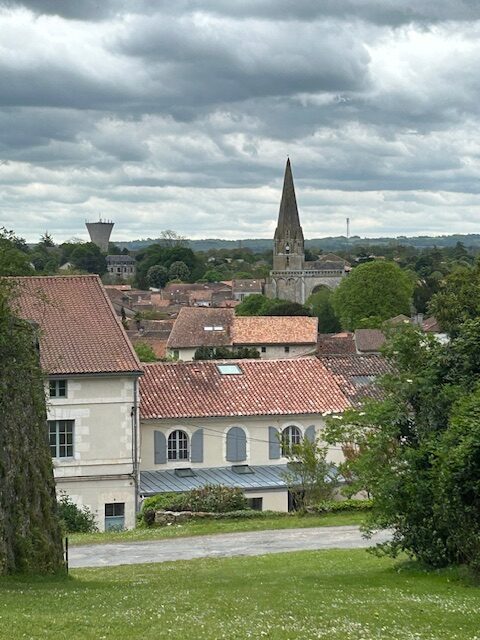
Thus, the house was by a side road of sorts, narrow and not often used. It explained the silence as we dined. This road I was later to use by daytime in my first visit to the nearby village on foot. The house sat in such a way that it’s “back” faced the last house in the village and faced what would be an ancient cemetery, older than the house. Intrigued by Susan’s revelation, my eyes traveled to the front of the house which had a large covered patio that looked out onto the grounds where Susan planted her “potager”, or vegetable garden. The garden ended a few feet from the front gate. Yes, the house was walled in.
Past the gates, obscured that evening with mist and a gentle rain, was the continuation of the road uphill, finally turning onto a fork. One fork led to the cemetery. I was riveted to their narrative, wondering how far the cemetery was. They replied that it was less than a mile, if that.
I had established that Susan and Fred chose an obscure if not remote location to call home. With only three hundred inhabitants in the village and the house’s physical location, they were guaranteed silence and peace, if not isolation. Their link, Fred told me, was their television, tuned and set to see all stations in France and overseas. Of course, they both had their mobiles and house phone.
I inquired about the gite which sat resting next to the barn where I was to sleep. The gite faced the back garden, one wall connecting to the sole barn where Fred kept his garden tools and what remained of a pigsty. beyond the gite, the wall faced the last house in the village. Mistakenly sensing a fear for my safety, Fred offered that the guesthouse or gite was perfectly secure. He offered that he always bolted the gate in front and that the walls were high and thick like the rest of the walls of the house.
The gite or guesthouse was built the same time as the house and adjoining barn. Above the barn was the farmer’s field. it was this field that connected to the cemetery beyond and is important to remember as the novel unfolds. I would later on walk on the edge of the field as I made my way back to the house, as I had discovered another gate which was left ajar.
Back to the house. I ended my repast, thanking my hosts for the lovely meal of lamb and olives. I made my way back out of the house by the side door which was a series of French doors, or “window” doors as the French called it. I discovered then how dark the surroundings were, bereft of any nearby habitation. As if in reply, floodlights came on, lighting my path towards the back of the home where the guesthouse sat and the barn next door was situated in wait.
As I walked past the barn, the ancient wooden door swung to the wind and I secured my rain jacket around my waist. I found myself relieved and happy to finally reach the heavy outer door of the gite. Pulling it with both hands, I undid the lock with the key Fred had provided and gratefully shut myself in for the night.
I slept with the kitchen lights on beneath the sole bedroom. One window looked out below into the field and the cemetery beyond to my left. I slumbered and finally slept my first night in the Dordogne.
CONTINUED in two weeks….